
Introduction
Purchasing an AC in especially in india it was not as simple it can be quite confusing, as walking into a store and picking one. Then, most people struggle to understand the difference between 1 ton and 1.5 ton models, and dealers often add to the more confusion.
Most of the buyers faces the similar situation. You enter a showroom asking which is best bedroom air conditioner, and the salesperson immediately suggests a 1.5-ton model, insisting on its superior cooling, but it’s important to remember that bigger is not always better.
If you are buy a larger AC than needed your up your electricity costs may increase. If are buying a smaller one then the room may not cool properly during peak summer time.
Let me explain clearly.
In some cities, especially Delhi, Hyderabad, nagpur in summer temperatures will easily touch 40°c to 50°C, and also poor ventilation and direct sun light that’s why choosing a right AC size becomes very important.
In this guide we will explore the differences between 1 ton and 1.5 ton ACs , including their room size, electricity consumption and to find best choice for Indian homes.
What Does Ton Mean in AC?
Many people mistakenly think that ton refers to the weight of the air conditioners but it actually indicates the AC Cooling capacity.
In air conditioners, tonnage means cooling capacity.
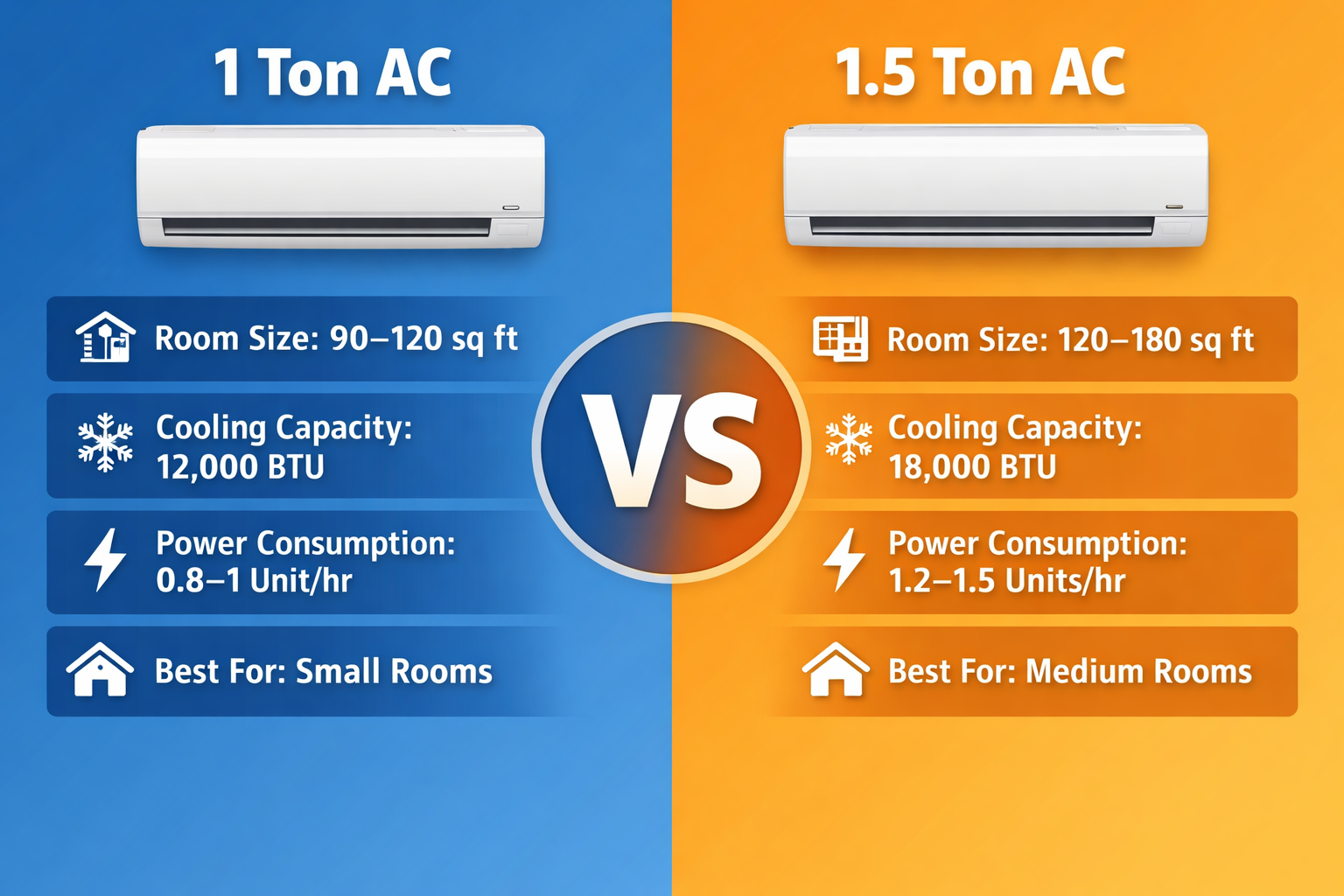
- 1 ton AC = 12,000 BTU per hour cooling capacity
- 1.5 ton AC = 18,000 BTU per hour cooling capacity
Simply put, a higher tonnage unit cools larger rooms more quickly.
However, choosing the right tonnage depends on:
- Number of people in the room
- Ceiling height
- Room size
- Sunlight exposure
- Local climate
This is main reason why comparing 1 ton AC vs 1.5 Ton AC is important before Purchasing.
1 Ton AC Best For Which Room?
A 1 ton AC is best suited for small spaces.
Room Size
Perfect room size for 1 ton AC room size:-
- 90 to 120 sq ft
Examples:
- Small bedroom
- Reading Room
- Office Cabin
Energy Consumption:
A standard 1-ton inverter AC typically uses about:
- 0.9 to 1 Unit Per Hour
This makes it relatively energy efficient.
Who Should Buy
A 1 ton AC is suitable if:
- Your room is small
- The room has limited sunlight
- Only 1–2 people stay in the room
- You want lower electricity bills
For example, if your guest bedroom is around 100 sq ft, a 1 ton AC is usually enough.
Pros
- Lower electricity usage
- more affordable price
- great for small spaces
Cons
- not ideal for larger areas
- Cooling may struggle during peak summer
1.5 Ton AC – Best For Which Room?
Now, let’s examine the larger choice in the comparison between a 1-ton AC and a 1.5-ton AC.
Room Size
Ideal 1.5 ton AC room size:
- 120 to 180 sq ft
Examples:
- Master bedroom
- Living room
- Large office cabin
Power Consumption
A 1.5 ton inverter AC usually consumes:
- 1.2 to 1.5 units per hour
However, inverter technology modifies compressor speed, leading to varying consumption levels.
Who Should Buy
A 1.5 ton AC is better if:
- For example: In a west-facing bedroom in Hyderabad with strong sunlight, a 1.5 ton AC will provide quicker cooling.
Pros
- Faster cooling
- effective for medium-sized rooms
- Better performance in extreme heat
Cons
- Increased energy usage
- Slightly higher price
Power Bill Analysis:
One common concern while comparing 1 ton AC vs 1.5 ton AC units is the cost of electricity.
Let take an simple example.
1 Ton AC
- Approx units/day: 6–7 units
- Monthly units: 180–210
1.5 Ton AC
- Approx units/day: 9–11 units
- Monthly units: 270–330
Electricity cost depends on your state taxes, but mostly the 1.5 ton AC electricity cost can be 20% to 40% higher.
However, inverter ACs with BEE 5 star rating are much more efficient and you can check the official original BEE Energy label for better understanding.
Final Conclusion:
So when it comes to 1 Ton AC vs 1.5 Ton AC the right choice depends mainly on your room size.
- Choose 1 ton AC if your room is under 120 sq ft.
- Choose 1 Ton AC if your room size under 125 sq ft.
- Choose 1.5 Ton AC if your room size is between 120 to 180 sq ft.
In short, match the room size to AC Capacity.
Before buying, check the BEE Star rating, inverter technology and warranty.